
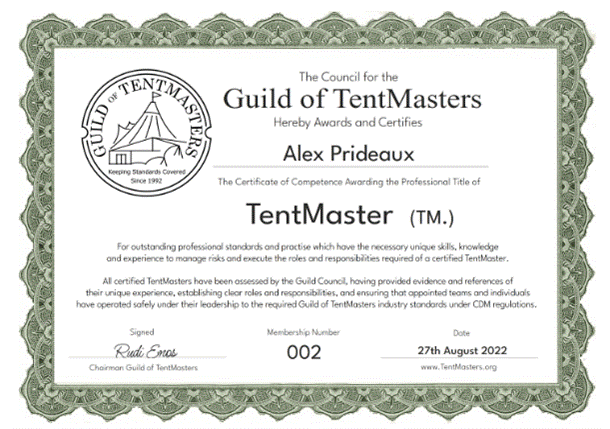
Attain the formal title of TentMaster TM
The Guild of TentMasters awards qualifications for life and work experience based upon your proven track record. The Guild is working on a pan industry basis in collaboration with ESITS, MUTA, the Events Industry Forum, the Association of Independent Festivals (AIF) and major employers across the events industry. The Guild is a not-for-profit company limited by guarantee.
There is no charge for these certificates.
Origins, purpose and mission
The temporary structures industry is at a turning point. For decades, expertise in erecting tents, marquees, stages and other temporary demountable structures was passed down through apprenticeship and hands on experience. Competence was measured by reputation, quality of work and peer recognition, not formal credentials. Today, regulations, European and British technical standards and the Construction Design and Management Regulations 2015 require verifiable, documented competence.
The Guild of TentMasters, founded in 1992 to improve standards for the temporary structures industry, now provides a pathway that combines formal assessment and certification with traditional craft knowledge, ensuring tent masters meet modern professional and legal standards. TentMasters is a not for profit organisation run by volunteers. It exists to improve standards in an industry where, historically, there were few formal qualifications. Because of the generosity of trade sponsors, membership has been offered free during the launch period, with modest annual fees expected thereafter.
Tent masters have been around for many years. It is the oldest form of construction in history, yet there has never been a coherent vocational route for the people who put tents up. Most events fall under CDM 2015, which requires a competent person to sign off a temporary structure. The Guild’s role is not to become another trade association, but to act as the professional body and clarion call that formalises competence where none existed before. It partners with organisations such as ESITS to set course standards and with MUTA to embed this competence within recognised best practice.
The Guild’s aims are to promote individuals to become accredited within their specialist field with their unique type of structure, to embrace ever evolving compliance and to act as a forum for advice, knowledge and education for better working practices. Its mission is to prioritise people, practise effectively, preserve safety and promote professionalism so that the TentMaster title is recognised as a skilled, safety critical role within the global construction and events industries.
A TDS (Temporary Demountable Structure) can be a tent but there are many TDS which are not tents. So, a stage without a roof is a TDS, as is a platform as is a scaffold as is a portacabin as is a seating grandstand without a roof. Which is why we prefer to call those structures with a membrane element, Fabric Roofed Structures or FRS.
When the load bearing roof membrane is added, the whole dynamic of the structure changes dramatically, as do the forces in the system, so a stage erector without roofing experience may not understand the scale of the increase in loads/forces of the roofed structure.